Solar & resilience
Power with a plan.
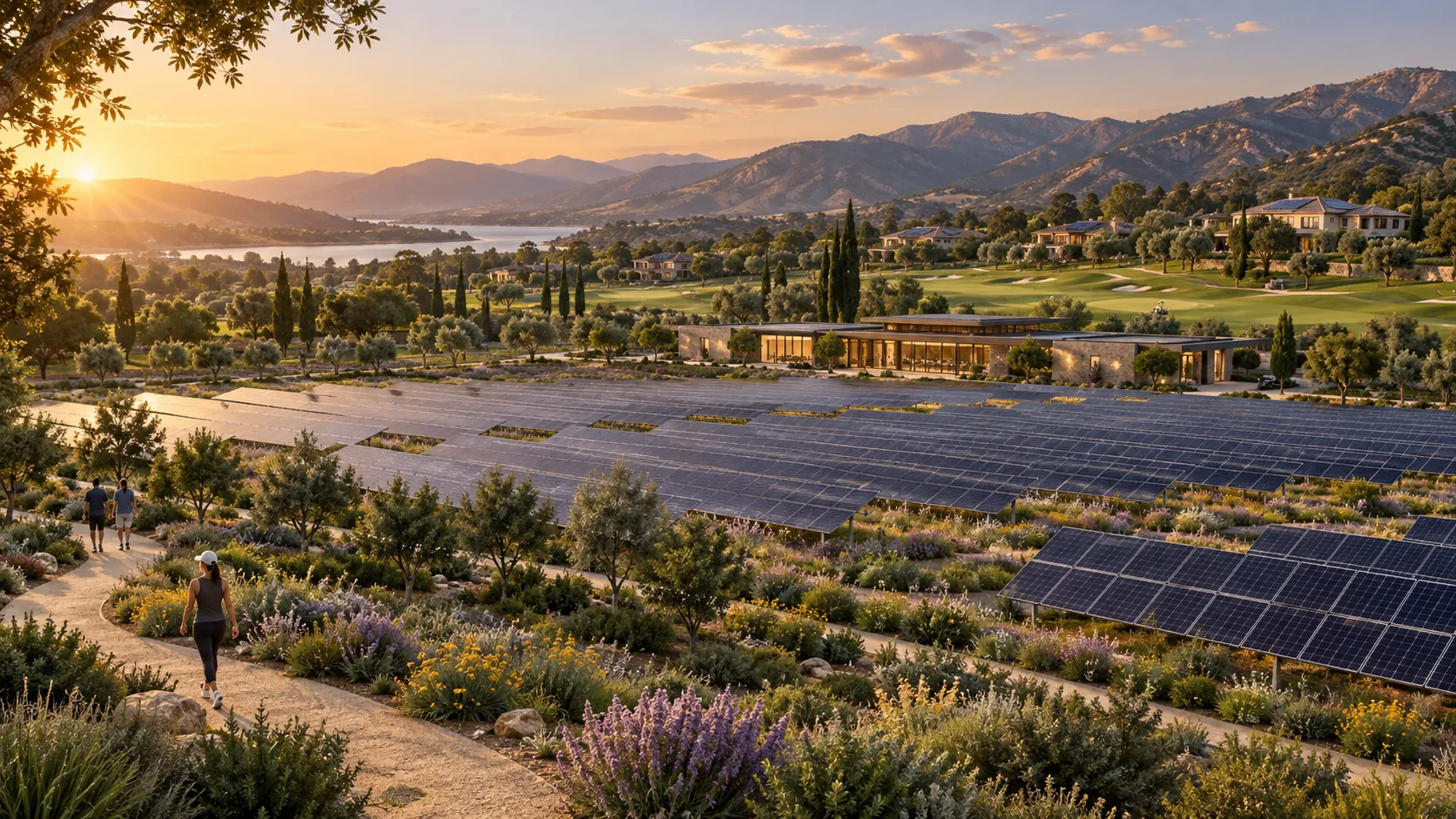
The Greens Project is envisioned as a solar-first, off-grid community network. A dedicated array, rooftop generation, storage, microgrid controls, and a reserve layer form the proposed architecture.
ILLUSTRATIVE CONCEPT RENDERINGBuilt for continuity
Power backed by a plan.
Solar generation is only the beginning. The proposed off-grid system pairs it with storage, local controls, priority circuits, and reserve generation so the community can plan for nighttime, cloudy weather, and equipment interruptions.
- 01 / THE SYSTEM
Generate
Solar on homes and shared buildings, plus a dedicated community array.
- 02 / THE SYSTEM
Store
A community battery reserve planned to carry energy into the evening and through interruptions.
- 03 / THE SYSTEM
Balance
Microgrid controls and inverters coordinate generation, storage, and demand.
- 04 / THE SYSTEM
Prioritize
Essential water, communications, security, and food systems receive a defined power plan.
- 05 / THE SYSTEM
Backstop
Dispatchable reserve generation is part of the design for extended low-solar periods.
Site by site, in the open. Capacity, expected backup duration, priority loads, reserve equipment, maintenance plans, and test results will be published when engineering is complete. No performance figures are claimed at this concept stage.
What happens when the sun sets
Designed for the whole day.
In normal conditions, rooftop and community solar would serve current demand and charge storage. After sunset or in lower output, stored energy would support the community. If a long low-solar period or equipment fault exceeds that reserve, dispatchable backup and a prioritized load plan would support essential services.
Final sizing must come from site-specific load modeling, weather data, utility design, safety review, and permitting. The first community will set the evidence standard for the wider network.
ILLUSTRATIVE / SCENARIO MODEL
Explore the scale of self-reliance.
Adjust a planning scenario to see how the housing mix affects energy demand. Every starting value is an illustrative assumption, including the housing counts and solar yield.
System losses: 18% · usable battery fraction: 80% · critical share: 35% · residential diversity: 45%. Shared loads: Water & wastewater 1,600 kWh/day; Golf irrigation & maintenance 1,200 kWh/day; Grocer, public center & amenities 2,400 kWh/day; Cart charging, lighting & security 600 kWh/day.
PV = daily energy ÷ (solar yield × 0.82). Usable storage = daily energy ÷ 24 × 0.35 × storage hours. Nominal storage = usable storage ÷ 0.8.
These estimates do not prove continuous off-grid operation. Hourly weather/load simulation, equipment selection and professional engineering remain required.
Download this scenario →Designing the complete system
Every load. Every season.
Water & wastewater
Pumping, treatment, storage and essential sanitation loads need measured schedules and a critical-power plan.
Golf & mobility
Irrigation, maintenance facilities and cart charging are scheduled around solar availability and course operations.
Distribution & controls
Inverter ratings, protection, local distribution, metering and load shedding are coordinated by qualified electrical designers.
Reserve & emergencies
Extended low-solar periods need dispatchable reserve, maintained fuel supply, essential circuits and documented emergency procedures.
Maintenance & lifecycle
Battery degradation, equipment replacement, inspections, spares and operating responsibilities are part of the design budget.
Commissioning & proof
Hourly simulation, safety review, islanded operation tests and published commissioning results establish site-specific performance.
Transparency by design
The numbers will be public.
There are no promised kilowatts or autonomy hours yet. Before any community opens, these site-specific figures and test results should be easy for prospective residents to find and understand.
Rooftop and community array sizes for each location.
Battery capacity and lifecycle assumptions.
Target hours for essential and whole-community loads.
Dispatchable backup equipment and fuel strategy.
Commissioning, maintenance, and resilience test results.
Follow the build
See how the vision takes shape.
Join the free interest list for project updates as locations, engineering, and community details develop.
Join the interest list